

A couple of Saturdays ago, between my son’s morning soccer game and loading two sand-crusted boogie boards into the back of my car, I overheard two dads talking by the sidelines.
One of them was scrolling through his phone, showing off a YouTube thumbnail featuring a guy on a yacht with the caption: “How I Make $5,000 a Month in Dividends and Quit My 9-to-5.”
“I’m thinking about throwing half my 401(k) into a couple of these 11% yield funds,” he said. “Let the payout cover the mortgage, and I can walk away from my job by 43.”
I didn't butt in. You don’t offer unsolicited clinical diagnoses at youth sporting events. But hearing someone treat an 11% dividend yield like a guaranteed paycheck gives me the exact same pit in my stomach as watching a beginner paddle an eight-foot foam board straight into a heavy, dredging shorebreak.
They don’t see the undertow.
The dream of "living off dividends" is appealing for a reason. Instead of selling off chunks of your portfolio during a brutal bear market to buy groceries, you simply sit back and let cash flow into your account while leaving your principal untouched. It feels clean, surgical, and stress-free.

The social media gurus peddling this dream routinely omit the three variables that will wreck you: taxes, healthcare, and capital degradation.
Let’s run the actual diagnostic on what it costs to live entirely off dividend cash flow in the United States.
The Clinical Formula: Stripping Away the Hype
The basic math behind dividend living looks deceptively simple:
Required Capital = Target Annual Cash Flow / Safe Portfolio Yield
If you need $60,000 a year and buy a product yielding 10%, you theoretically only need $600,000.
That calculation works only on paper. In the real world, chasing an 8% to 12% yield is the financial equivalent of pumping an aging athlete full of cortisone shots. It masks the structural failure underneath until the tendon snaps.
When a company or an ETF offers a double-digit yield, it is almost always compensating investors for severe risk:
- The Sinking Ship: A stock's yield spikes because its share price collapsed after a disastrous quarter. A dividend cut usually follows closely behind.
- The NAV Eater: High-yield synthetic covered-call funds often pay you distributions by eroding their own net asset value (NAV). They are essentially handing you back your own principal while permanently capping your upside.
If you want a dividend stream that survives 40 years of market cycles, inflation, and unexpected medical bills, you cannot live in the speculative 10% danger zone. A durable, inflation-beating dividend growth portfolio (composed of dividend aristocrats, broad dividend-growth ETFs, and resilient cash-flow compounders) reliably yields between 3.0% and 3.75%.
The Silent Run-Rate Killers at 40
When you leave full-time employment in your early 40s to live off portfolio income, two major structural expenses hit your balance sheet immediately:
1. The Healthcare Chasm
When you leave corporate employment, your employer stops subsidizing your family’s health coverage. Until you qualify for Medicare at 65, you are entirely on the private or ACA marketplace. For a family of four, comprehensive healthcare premiums combined with maximum out-of-pocket exposure easily cost $18,000 to $24,000 per year in after-tax cash.
2. The Tax Drag
Even qualified dividends held in a standard taxable brokerage account are taxed at 0%, 15%, or 20% depending on your total income bracket, plus state income taxes (which in California can push your combined drag well over 20%). If you own non-qualified high-yield funds or REITs, those payouts are taxed at your ordinary income rate.
Running the Tiers: What Do You Actually Need?
Let’s look at three realistic lifestyle profiles for an American household, factoring in baseline taxes, health coverage, and a conservative, sustainable gross dividend yield of 3.5%.
The Suburban Family Reality ($3.2 Million)
To generate a clean $90,000 in spendable cash for a family of four—handling a mortgage, sports gear, groceries, family vacations, and private healthcare—you need roughly $112,000 in gross dividend distributions.
At a durable 3.5% yield, your target balance isn't $600,000. It is $3.2 million parked in high-quality, dividend-growing assets.
The Pathology of the "Yield Trap"
If you try to cheat this math by forcing a 7% or 8% yield on a $1.5 million portfolio to hit that same income target, here is how the pathology unfolds:
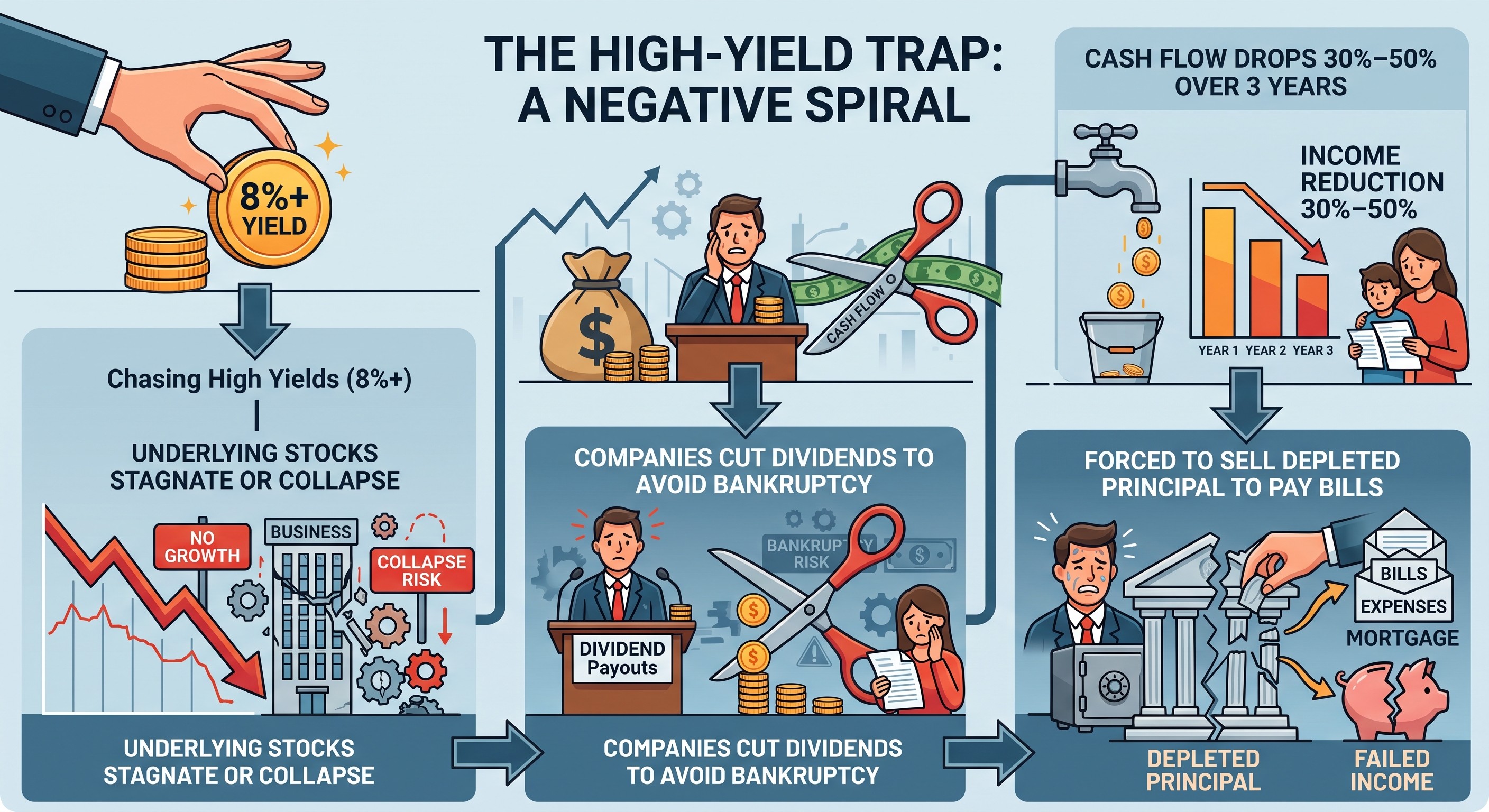
A healthy company pays out only 40% to 60% of its net earnings as dividends, reinvesting the rest back into the business to ensure earnings grow faster than inflation.
When a company's payout ratio climbs past 90%, it is starving its own operational future just to keep dividend investors from fleeing. The moment economic headwinds hit, that payout gets slashed, the stock drops 25% overnight, and your family's passive income lifeline collapses.
Broker Diagnostics: Optimizing the Machinery
If your goal is to transition your balance sheet toward cash-flow generation, your brokerage platform needs to function like a precision instrument:
- Automated Partial DRIP Controls: During your accumulation phase, you want every penny automatically reinvested into fractional shares. Once you transition to living off payouts, you need a platform that lets you selectively toggle DRIP on or off per ticker, routing specific cash payouts directly to your primary checking sweep.
- Scheduled Distribution Rails: Look for brokers that allow automated, recurring cash transfers to your personal bank account. A proper platform lets you automate monthly income transfers derived strictly from your accrued cash balance without triggering involuntary share liquidations. Institutions like Fidelity, Charles Schwab, or Interactive Brokers excel here.
- Granular Tax Categorization: When tax season rolls around, tracking the difference between qualified distributions, ordinary dividends, and return of capital (ROC) can become an administrative headache. Your platform must provide clean, accurate, real-time 1099-DIV forecasting dashboards so you aren't blindsided by estimated quarterly tax obligations.
Walking away from the grind to live off dividends isn't an internet myth, but it isn't an overnight shortcut, either.
It is a long-term engineering project. It requires building a capital base large enough to respect the real cost of living, while ignoring the sirens promising double-digit payouts with zero downside.
Get the math right, protect your principal, and build an engine that runs smoothly regardless of what the market does next.