

A few months ago, around 5:30 AM before the sun cleared the horizon, I was sitting in my kitchen with a mug of black coffee, checking my accounts before heading out to catch the morning tide.
My wife and I had parked about $18,000 in my taxable brokerage account. It was a combination of dry powder—waiting for a sensible market entry—and a reserved buffer for our daughter’s upcoming orthodontic work and summer camp fees. Safe, unallocated, patient capital.
Out of curiosity, I pulled up the statement history to see what that idle cash had generated over the previous quarter.
Seventy-four cents.
I did the math twice to make sure my pre-caffeine eyes weren't failing me. In an era where short-term Treasury yields and institutional money market rates have hovered between 4% and 5%, my $18,000 had earned less than the price of a gumball.
In clinical medicine, you worry about arterial bleeds because they are loud, dramatic, and demand immediate intervention. But the insidious killer in trauma care is often the slow, capillary micro-leak—a gradual loss of blood pressure that goes unnoticed until the vitals crash.
Your brokerage account has a micro-leak. And your broker is counting on you being too busy with your life to notice it.
The Pathology of the "Cash Sweep"
When you sell a stock, receive a quarterly dividend, or deposit money into your account, that uninvested capital doesn't just sit in a digital vault. It gets placed into what brokers call a Cash Sweep Program.
Here is what happens behind the curtain:
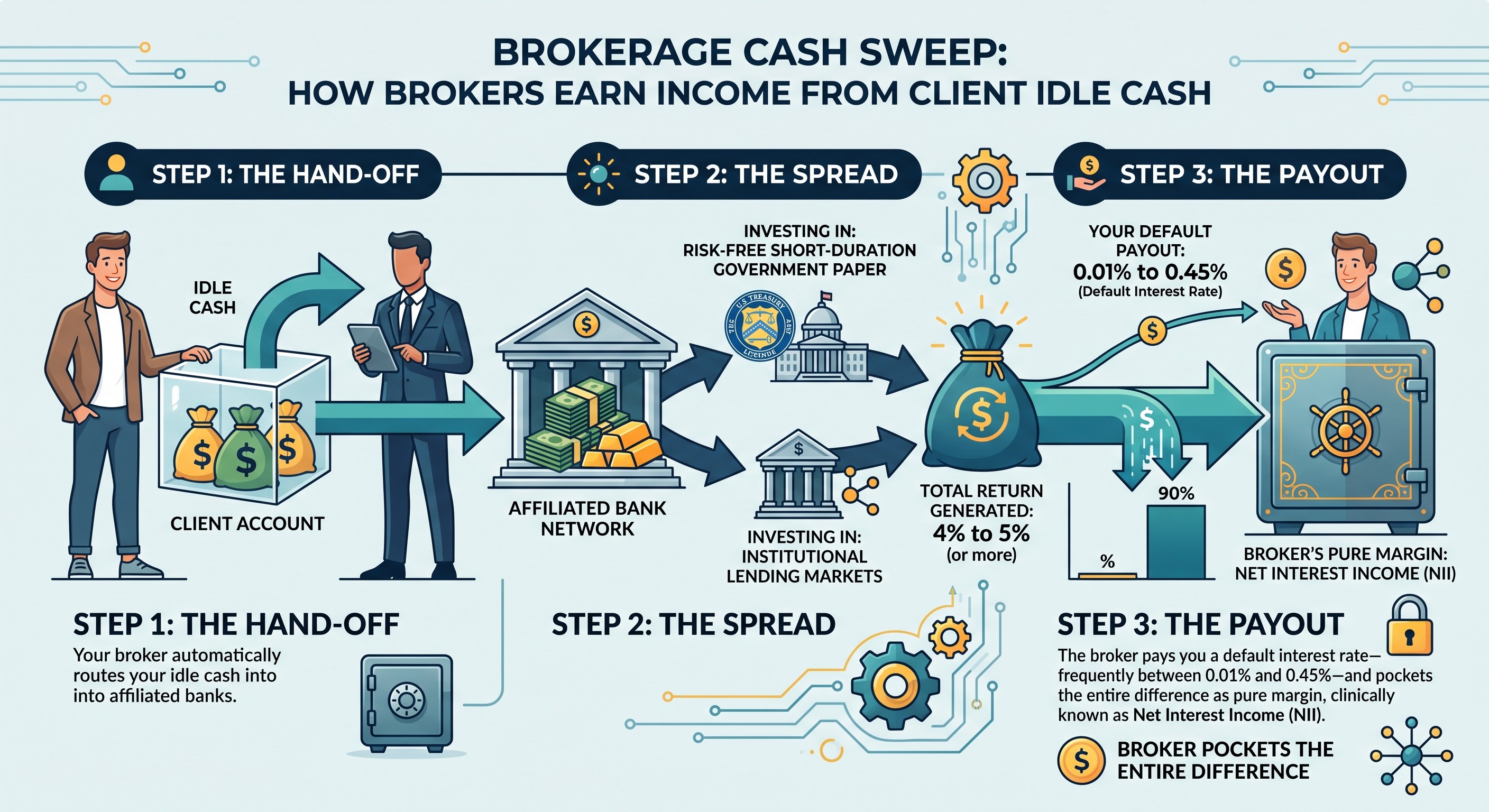
- The Hand-Off: Your broker automatically routes your idle cash into affiliated banks.
- The Spread: Those banks turn around and deploy that capital into risk-free short-duration government paper or institutional lending markets, pulling in 4% to 5% or more.
- The Payout: The broker pays you a default interest rate—frequently between 0.01% and 0.45%—and pockets the entire difference as pure margin, clinically known as Net Interest Income (NII).
They aren't breaking the law. It’s written right there on page 47 of the account agreement you scrolled through and clicked "Agree" on while waiting in the school pick-up line.
For the brokerage, this is a multi-billion-dollar business model. For a 40-something trying to build a durable runway for his family, it is an unnecessary drag on your balance sheet.
Running the Numbers: What Does the Leak Actually Cost You?
Let’s look at the actual balance-sheet drag on a family over time. Suppose you keep an average uninvested cash balance of $15,000—whether that’s dry powder, tactical trading capital, or incoming dividends waiting to be reinvested.
Over a five-year window, that micro-leak drains nearly $3,700 out of your family’s balance sheet.
That isn't monopoly money. That’s two semesters of junior college tuition, four years of club soccer fees, or a complete upgrade of your household emergency supplies. Leaving that money with an intermediary because of administrative laziness isn't being "chill"—it's negligent triage.
The 3-Step Triage: How to Plug the Leak Today
You don't need to close your accounts or panic-move your capital. You just need to apply a little surgical discipline to your platform settings.
1. Audit Your Default Sweep Rate
Log into your account during normal business hours, head to your account balances tab, and click directly on the line item for "Cash" or "Core Position."
If you see an acronym tied to a bank deposit program paying under 1%, your leak is active.
If your broker lets you change the default core position (some platforms allow you to choose a government money market fund as your primary holding pen), toggle it immediately.
2. Learn the "Manual Park"
Certain legacy brokerages intentionally make auto-sweeps anemic because it protects their corporate bottom line. However, they will still allow you to manually purchase their proprietary, high-yielding money market funds (yielding prevailing short-term rates) without commission.
- Find the zero-fee, Treasury-backed money market ticker on your platform.
- When cash sits idle for more than a few days, manually submit a buy order for that fund.
- When you're ready to deploy into equities, sell the exact amount you need—most major platforms settle these liquidations seamlessly for trade execution.

3. Vote With Your Capital
If your broker intentionally hides sweep rates, penalizes you for holding money market instruments, or forces you to navigate five menus just to find your APY, take a long look at the alternatives. Modern execution-focused platforms like Interactive Brokers and competitive discount custodians are increasingly offering automatic sweeps into competitive yields as a baseline standard, not a premium perk.
When you're out on the water, you don't fight the ocean's current; you read the drift, adjust your position, and catch the swell that works for you.
Your cash should be doing the exact same thing. It should be pulling a continuous shift—compounding quietly in the background—even while you're sleeping, working, or cooking dinner with your kids.
Go check your platform vitals. Plug the leak.