

If you walk into an emergency room with a temperature of 104°F, the triage nurse doesn’t congratulate you on your elevated stats. A high number isn't a sign of peak vitality; it’s a symptom of a system under acute distress.
Yet, when retail investors look at dividend ETFs, they frequently treat yield exactly the opposite way. They sort by "Highest Yield," see a fund pumping out 11.5%, and hit buy—ignoring the fact that the underlying index might be cannibalizing its own net asset value or holding dying companies to maintain that payout.
In 2026, the financial media is still flooded with algorithmic noise pushing synthetic option-income funds and leveraged yield traps. If you are building a capital engine designed to pay for your family's mortgage, healthcare, and eventual retirement, you cannot afford to invest in financial junk food.
We need a clinical approach. We need sustainable capital engines with low structural drag, strict balance-sheet discipline, and dividends that grow faster than inflation.
Here is the exact diagnostic criteria an ETF must pass to make the cut, and the four funds actually worth holding in 2026.
The Screening Protocol (The Lab Panel)
Before a ticker even makes it to the watchlist, it has to pass three structural tests:
- Constituent Health (The Balance Sheet Check): A high yield means nothing if the underlying companies are drowning in debt to fund the dividend. The index methodology must screen for free cash flow, return on equity (ROE), and low debt-to-equity ratios.
- The Payout Ratio Ceiling: A healthy company pays out a portion of its earnings (usually 40% to 60%) and reinvests the rest to ensure future growth. If a fund is packed with companies paying out 90% of earnings, a dividend cut is imminent the moment a recession hits.
- Low Friction (Expense Ratio & Tax Drag): The fund must cost nearly nothing to own (under 0.10% expense ratio) and its distributions must be ≥95% Qualified Dividend Income (QDI) to minimize the tax drag in standard brokerage accounts.
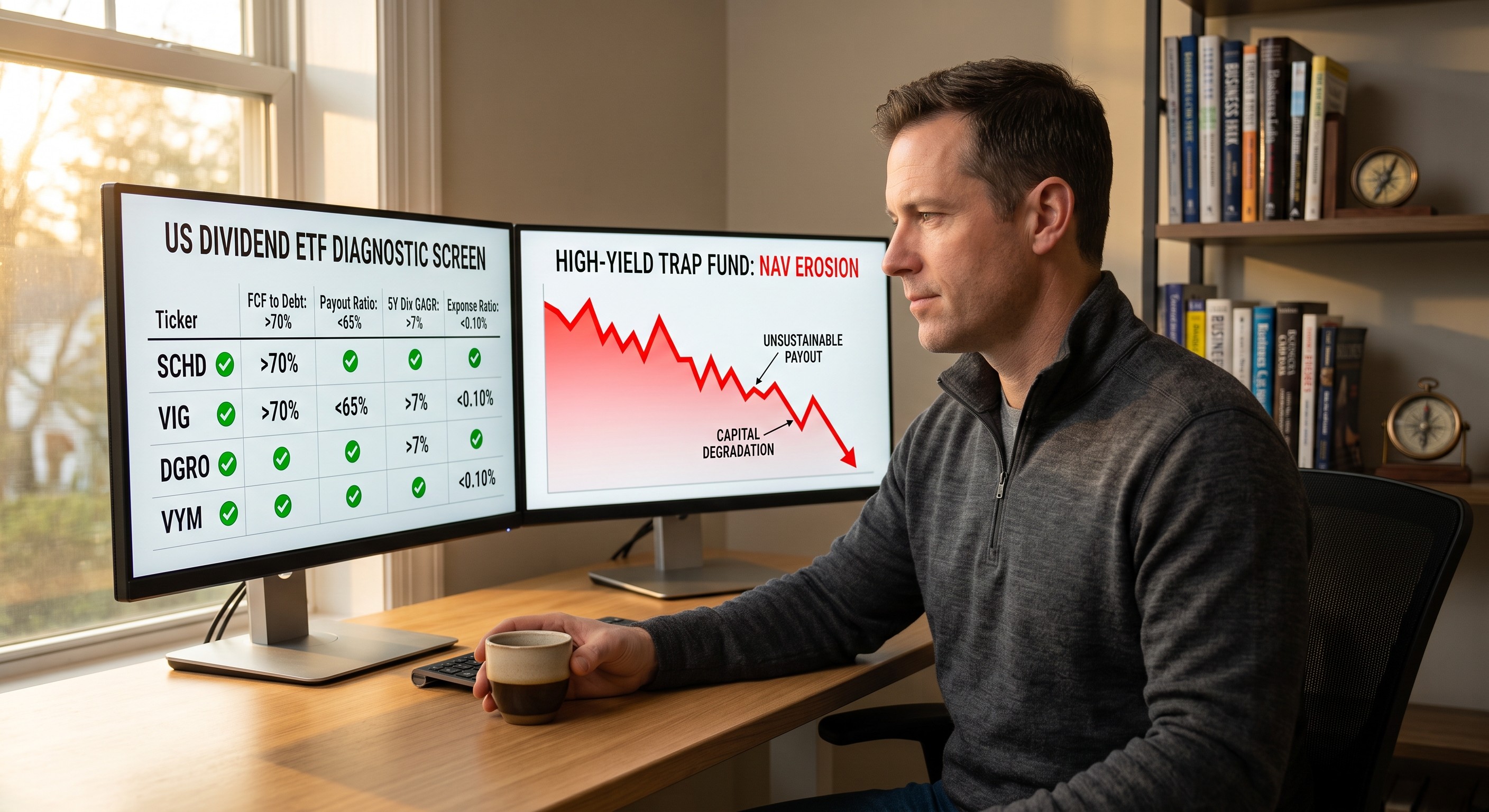
The Core Prescriptions: The Top US Dividend ETFs for 2026
1. The Bedrock Anchor: Schwab U.S. Dividend Equity ETF (SCHD)
- Expense Ratio: 0.06%
- Current Yield (Approx.): ~3.4%
The Clinical Case: If you are building a cash-flow portfolio, SCHD is the foundation. It tracks the Dow Jones U.S. Dividend 100 Index, which is arguably the strictest fundamental screen in passive investing. To even be considered, a company must have 10 consecutive years of dividend payments. From there, it is ruthlessly ranked by cash flow-to-total debt, return on equity, indicated dividend yield, and 5-year dividend growth.
The SJ Verdict: Low drag, strict balance-sheet discipline, zero gimmicks. It automatically weeds out corporate zombies.
2. The Growth Compounder: Vanguard Dividend Appreciation ETF (VIG)
- Expense Ratio: 0.06%
- Current Yield (Approx.): ~1.8%
The Clinical Case: Yield isn’t everything; purchasing power matters. VIG tracks the S&P U.S. Dividend Growers Index, requiring companies to have increased their base dividend for at least 10 consecutive years while strictly excluding the top 25% highest-yielding stocks to avoid yield traps.
The SJ Verdict: This is your hedge against inflation. You accept a lower starting yield today because the historical dividend growth rate ensures your cash flow will likely double every 7 to 8 years. It belongs heavily in the accumulation phase of any portfolio.
3. The Quality Alternative: iShares Core Dividend Growth ETF (DGRO)
- Expense Ratio: 0.08%
- Current Yield (Approx.): ~2.3%
The Clinical Case: DGRO operates similarly to VIG but uses a slightly different diagnostic framework. It requires only 5 years of consecutive dividend growth, but it enforces a hard payout ratio ceiling of 75%. This ensures every company inside the fund has a wide safety margin to protect the dividend during an economic contraction.
The SJ Verdict: An excellent counterpart or alternative to VIG. By requiring only 5 years of growth, it captures newer tech and healthcare companies initiating aggressive dividend policies earlier than VIG's 10-year requirement allows.
4. The Broad Value Foundation: Vanguard High Dividend Yield ETF (VYM)
- Expense Ratio: 0.06%
- Current Yield (Approx.): ~2.9%
The Clinical Case: VYM doesn’t rely on complex fundamental scoring; it simply takes the top half of dividend-paying US equities (excluding REITs) and market-cap weights them. It provides massive, cheap diversification across over 400 financial, industrial, and consumer defensive companies.
The SJ Verdict: Dependable, deep liquidity, and ultra-low cost. If you want broad US value exposure without the concentration risk of SCHD, VYM is the workhorse.
The Autopsy: The Covered Call Dilemma (JEPI / JEPQ)
We have to address the elephant in the room. If you spend five minutes on financial social media, someone will tell you to buy high-distribution covered call funds like JEPI (JPMorgan Equity Premium Income ETF) to "retire early."
Treat these funds like a controlled substance.
These are not traditional dividend growth engines. They generate high single-digit or low double-digit distributions by selling call options on the underlying index.
- Tax Inefficiency: Because the distributions are generated from option premiums, they are taxed as ordinary income, not favorable qualified dividends. In a taxable account, the tax drag is brutal.
- Capped Upside / Full Downside: By selling call options, you forfeit the upside if the market goes on a massive run, but you still absorb the vast majority of the damage during a crash.
SJ’s Prescription: Keep these out of taxable brokerage accounts. If you use them at all, limit them strictly to tax-advantaged accounts (like an IRA) during your actual drawdown phase when you need raw current income. They do not belong in a 35-year-old’s accumulation portfolio.
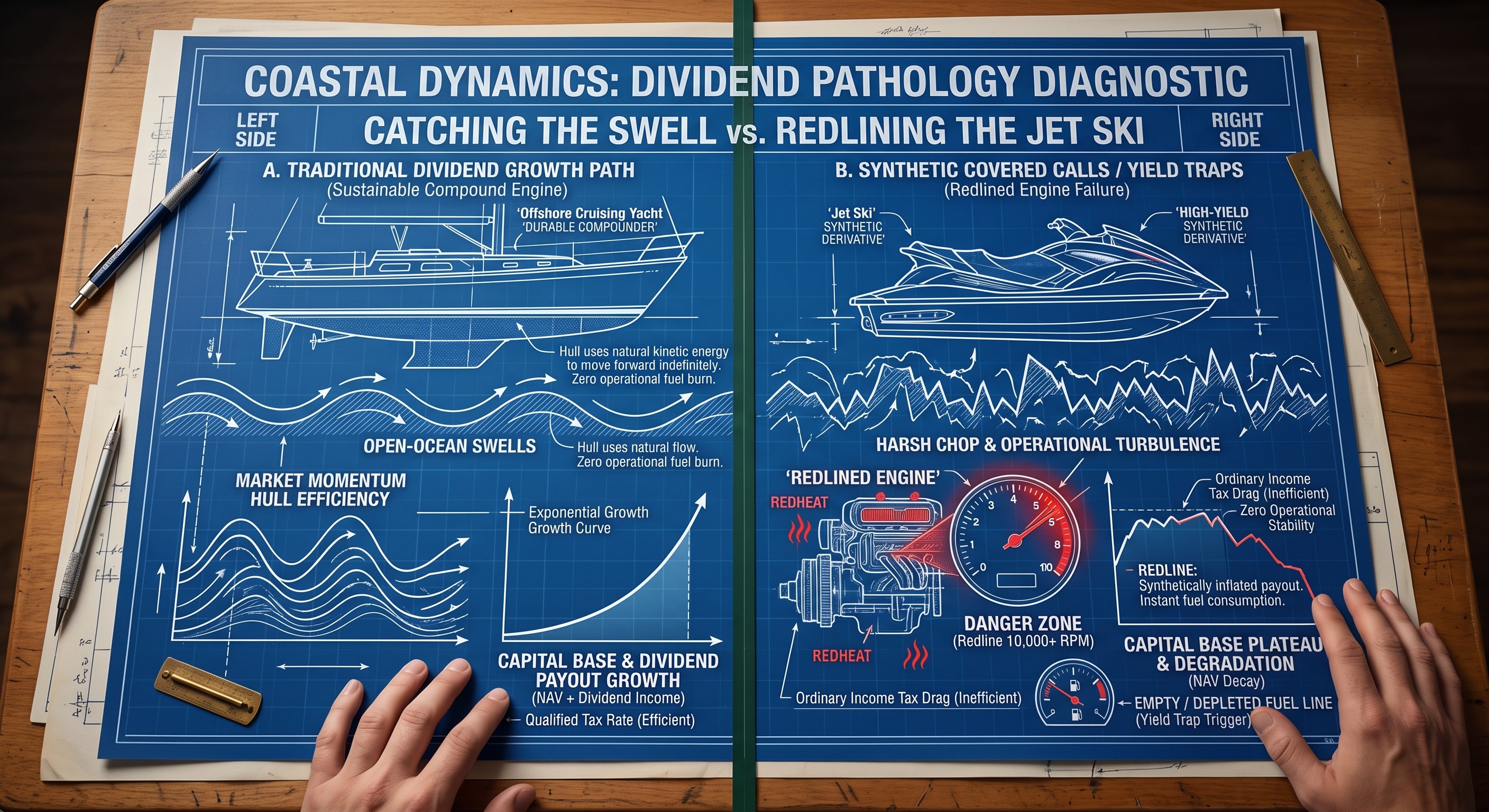
Execution Diagnostics: Optimizing Your Platform
Picking the right ETF is only half the battle. Your brokerage platform is the plumbing that makes the engine work. If you are serious about dividend compounding, you need a broker that offers:
- Fractional DRIP (Dividend Reinvestment Plan): The platform must allow automated, commission-free dividend reinvestment down to the cent. Do not let dividend cash sit idle in a 0.15% sweep account.
- Dynamic Reinvestment Tools: Modern brokers offer "pie" or "target-weight" automation, allowing you to pool all ETF dividends and automatically funnel that cash into whichever ETF is currently under its target allocation. Platforms like M1 Finance or Trading 212 dominate this space.
- Clean Tax Categorization: Come tax season, you need real-time 1099-DIV forecasting dashboards so you can easily track qualified vs. ordinary distributions without a spreadsheet headache.
Actionable Blueprint: Two Allocation Models
How you blend these funds depends entirely on your life stage.
Model 1: The Accumulator (Age 25–45)
Objective: Maximize long-term total return and aggressive dividend growth.
- 50% VIG or DGRO (The Growth Compounders)
- 40% SCHD (The Bedrock Anchor)
- 10% VYM (Broad Value Support)
Model 2: The Near-Retiree (Age 50+)
Objective: Maximize current safe yield, lower volatility, and preserve capital.
- 50% SCHD (Maximum sustainable current yield)
- 30% VYM (Broad diversification and stability)
- 20% VIG or DGRO (Inflation protection for the long tail)
Ignore the sirens promising 12% yields. Get the structural math right, keep your costs near zero, and let the compounding engine do the heavy lifting while you get back to your life.