

Most personal finance advice fails because it swings between two useless extremes: theatrical austerity and reckless speculation. On one end, financial gurus tell you that skipping a four-dollar espresso will somehow make you a millionaire. On the other, social media feeds peddle 12% synthetic yield traps and speculative crypto trades disguised as early retirement.
Both miss the point entirely.
Money is not a moral test, and it is not a scorecard for impressing strangers. Money is civil engineering. It is an operational engine designed to convert your daily energy into reliable, long-term autonomy. If the engine has structural leaks, high friction, or bad plumbing, it breaks down under pressure—no matter how much horsepower you pump into it.
If you want to strip out the noise, protect your capital, and build a system that runs cleanly without demanding 60 hours a week of your mental bandwidth, these are the 14 operating rules that actually survive contact with reality.
Phase 1: Upstream Plumbing (Defense & Capital Protection)
1. Pay Yourself First (Automated Capital Allocation)
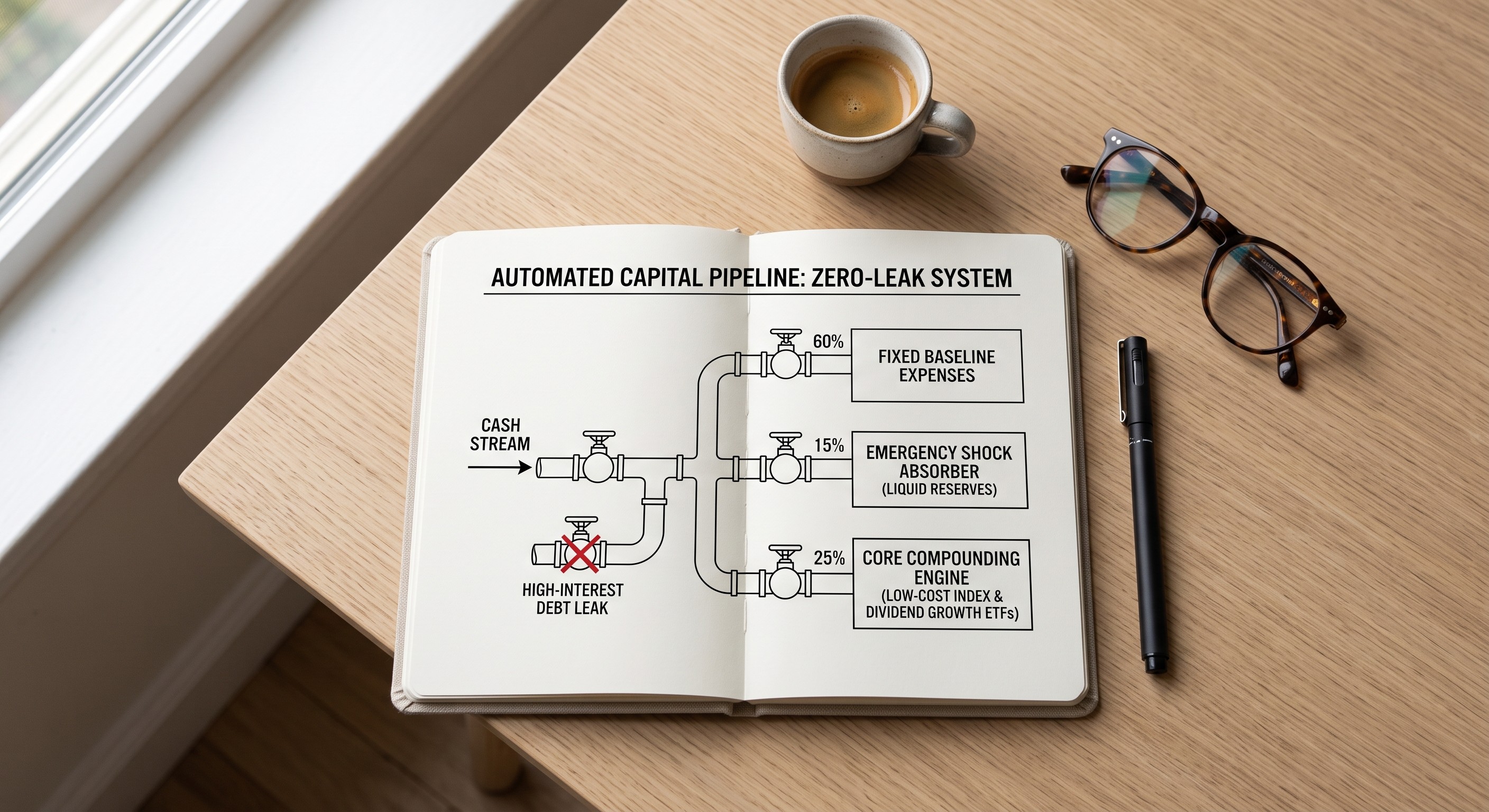
Treat your future self like an aggressive, non-negotiable creditor. If you wait to invest whatever remains at the end of the month, the answer will almost always be zero. Lifestyle expenses expand to consume whatever liquidity sits visible in a checking account. The day capital lands in your account, route a fixed percentage straight into your investment pipeline before a single discretionary dollar gets spent.
2. Build the Shock Absorber (Liquid Cash Reserves)
A portfolio without cash reserves is an engine without oil. Keep 3 to 6 months of true, bare-bones operating expenses locked in a liquid, high-yield cash sweep or Treasury bill ladder. This capital does not exist to maximize yield; it exists to buy you emotional insulation. When the roof leaks or an economic storm hits, this buffer prevents you from being forced to sell your long-term equities at the bottom of a market drawdown.
3. Treat Consumer Debt as a Code Red
Carrying a balance on a 22% credit card while trying to invest in an index fund yielding 8% is financial self-harm. You cannot out-invest a high-interest compound leak. Consumer debt is a guaranteed negative return that compounds against your net worth daily. Clear toxic debt aggressively before you pretend to be an investor.
4. Audit the Macro Leaks (The "Big Three")
Stop obsessing over grocery coupons while overspending on your mortgage and car payment. Housing, transportation, and food account for roughly two-thirds of the average household budget. If you drive a reliable, depreciated vehicle and keep your fixed housing costs under 30% of your take-home pay, you can drink all the coffee you want without moving the needle on your financial trajectory.
Phase 2: Friction Reduction (Behavioral Mechanics)
5. Eliminate Discipline Through Full Automation
Willpower is a finite, unreliable biological resource. Do not rely on daily discipline to execute your wealth plan. Automate your transfers, activate fractional dividend reinvestment (DRIP), and set up scheduled buys for your core ETFs. When the plumbing runs automatically on the 1st and 15th of every month, your portfolio compounds quietly in the background whether you feel motivated or not.
6. Enforce the 72-Hour Friction Rule
Impulse spending is rarely about the physical item; it is about chasing an instant dopamine hit to decompress from a stressful workday. Whenever you are tempted to buy a non-essential item over $100, enforce an unconditional 72-hour cooling-off period. Nine times out of ten, once the emotional spike clears, the desire to own the object evaporates with it.
7. Suppress Lifestyle Creep (Operating Leverage)
When your income increases through a promotion, bonus, or career shift, resist the instinct to immediately upgrade your baseline lifestyle. Take at least 70% of every raise and direct it immediately into your investment allocation, leaving the remaining 30% for quality-of-life adjustments. By widening the spread between what you earn and what you burn, you manufacture personal operating leverage.
8. Stop Subsidizing the Opinions of Strangers
A significant portion of modern financial anxiety is self-inflicted: spending money you don’t have, to buy assets you don’t need, to impress people you don’t even like. True wealth is silent. It is the mortgage-free title, the compounding brokerage account, and the calendar with empty afternoons. Conspicuous consumption is simply a tax paid on insecurity.
Phase 3: The Compounding Engine (Asset Selection)
9. Build on Low-Drag Core Exposure
You do not need to outsmart Wall Street to win. In fact, trying to beat institutional quantitative algorithms is the fastest way to bleed fees and underperform. Anchor your portfolio in low-cost, broadly diversified index funds and fundamentally screened dividend growth ETFs (like SCHD, VIG, or total market indexes). Keep expense ratios under 0.10% and let collective economic productivity do the heavy lifting.
10. Respect Compounding Asymmetry
Compounding is heavily backloaded. In a 25-year investment horizon, the majority of your total wealth accumulation occurs in the final six years. The math feels slow, dull, and unrewarding in years one through five, which is precisely where impatient investors quit or pivot into reckless high-yield traps. Time in the market will always beat tactical timing. Sit on your hands and let the exponential curve mature.
11. Stay Within Your Circle of Competence
If you cannot explain how a company makes its free cash flow—or how a financial product generates its payout—on a single cocktail napkin, do not put your capital into it. Complexity in personal finance is usually designed to enrich the person selling the product, not the person buying it. Stick to transparent balance sheets and straightforward structures.
12. Separate Cash-Flow Engines from Cash-Drain Liabilities
An asset puts money into your pocket; a liability takes money out. A high-end luxury vehicle or a boat is a depreciating consumer toy, not an investment. There is nothing wrong with owning toys if you have the surplus capital to fund them, but never confuse capital expenditures that produce passive cash flow with items that demand continuous maintenance, registration, and insurance.

Phase 4: The Sovereign Horizon (Execution & Purpose)
13. Focus on the Uncapped Side of the Ledger
Frugality has a mathematical floor; you can only cut your living expenses down to zero. Your earning potential, however, has no ceiling. While tightening defensive leaks is mandatory in the early stages, long-term wealth velocity requires playing offense. Continually upgrade your high-leverage skills, build career capital, and raise your primary cash flow so you can feed larger amounts into the compounding machine.
14. Treat Money as a Tool for Time Sovereignty
The ultimate dividend money pays is not a sports car, a luxury watch, or an oversized estate. It is the ability to wake up on a Tuesday morning and decide what you are going to do with your day. It is the freedom to say "no" to toxic bosses, bad clients, and soul-crushing commutes. When your capital covers your living costs, you don’t just retire—you reclaim ownership of your life.
Money management isn't about restriction; it's about engineering freedom. Fix the plumbing, protect your downside, and let the machinery quietly build your runway.